
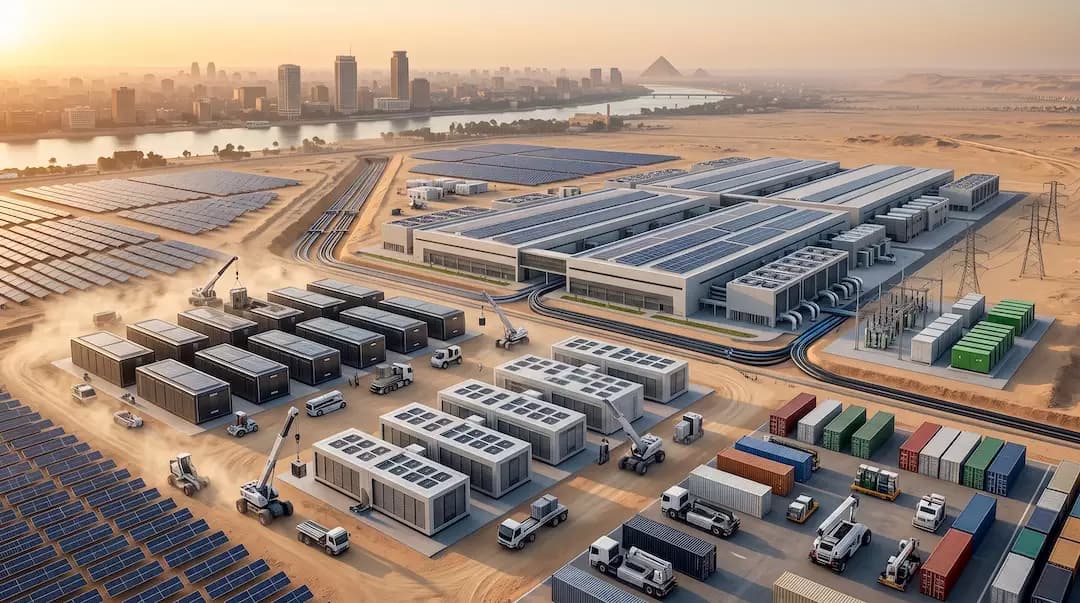
Huawei Technologies has submitted an offer to the Egyptian government to establish data centers specialized in artificial intelligence, aiming to provide services to government sectors such as military, security, and surveillance fields. This step could enhance the Chinese company's presence in the AI chip market outside China, while simultaneously opening a new front for technological competition between Beijing and Washington.
According to a Bloomberg report, Huawei's offer came in response to a tender issued by Cairo, and includes supplying 1,408 Ascend 950 chips dedicated to training AI models, along with 600 additional Ascend 950 or Ascend 910B chips to run the models after training.
Documents seen by the agency showed that Huawei set a one-year plan to implement the required infrastructure.
Egypt: A New Arena for US-Chinese Competition
If the deal is completed, the project will represent an important step in China's efforts to expand its presence in the global AI infrastructure market. It will also give Huawei a new foothold in the Middle East and Africa through the Egyptian market.
On the other hand, the United States moved after reviewing the Chinese offer. The US State Department contacted major tech companies, including Nvidia, AMD, and Microsoft, to discuss forming an alliance capable of presenting a competing offer to Cairo.
The companies involved did not comment on these contacts, nor did the Egyptian government or Huawei issue a response to inquiries regarding the tender, according to the report.
Huawei Chips Facing US Influence
The competition comes amid increasing US restrictions on exporting advanced AI technologies and chips to several markets, amid Washington's fears over the expanding use of Chinese technology.
The United States has warned since 2025 against using certain Huawei AI chips without obtaining the necessary approvals, noting that doing so could expose users to sanctions or legal action under export control rules.
The Egyptian tender, according to the report, is one of the early cases where the United States and China are competing directly over a government project to build AI infrastructure.
A US State Department spokesperson said Washington is in talks with dozens of countries about enhancing "American leadership in AI," stressing that US technology provides advanced capabilities while respecting countries' sovereignty.
Partnership with a Chinese Surveillance Company
Huawei's offer includes a partnership with iFlytek, a Chinese company specializing in facial and voice recognition and smart surveillance technologies, which the United States blacklisted in 2019.
According to the documents, the proposed applications include systems for recognizing people and vehicles relying on national databases, along with integrated urban surveillance systems that provide what the company described as a "comprehensive panoramic view of the city."
A Test of Huawei's Ability to Expand Globally
Although the total number of chips in the deal, amounting to 2,008, remains limited compared to the massive AI infrastructure projects implemented by Western companies, the project represents an important test of Huawei's ability to market its processors outside the Chinese market.
It could also give the company an opportunity to prove international demand for the Ascend chip series, which it is developing to compete with Nvidia's dominance in the AI processor market.
The report notes that Huawei's success in securing the project could set an important precedent in emerging markets, paving the way for the company to expand its activities in Africa, Latin America, and Southeast Asia, at a time when AI infrastructure is turning into one of the most prominent arenas of technological and geopolitical competition between the United States and China.
It is noteworthy that Egypt has recently become one of the most prominent countries seeking to consolidate its position as a regional AI hub in Africa, as the second national AI strategy aims to raise the sector's contribution to 7.7% of GDP by 2030.