
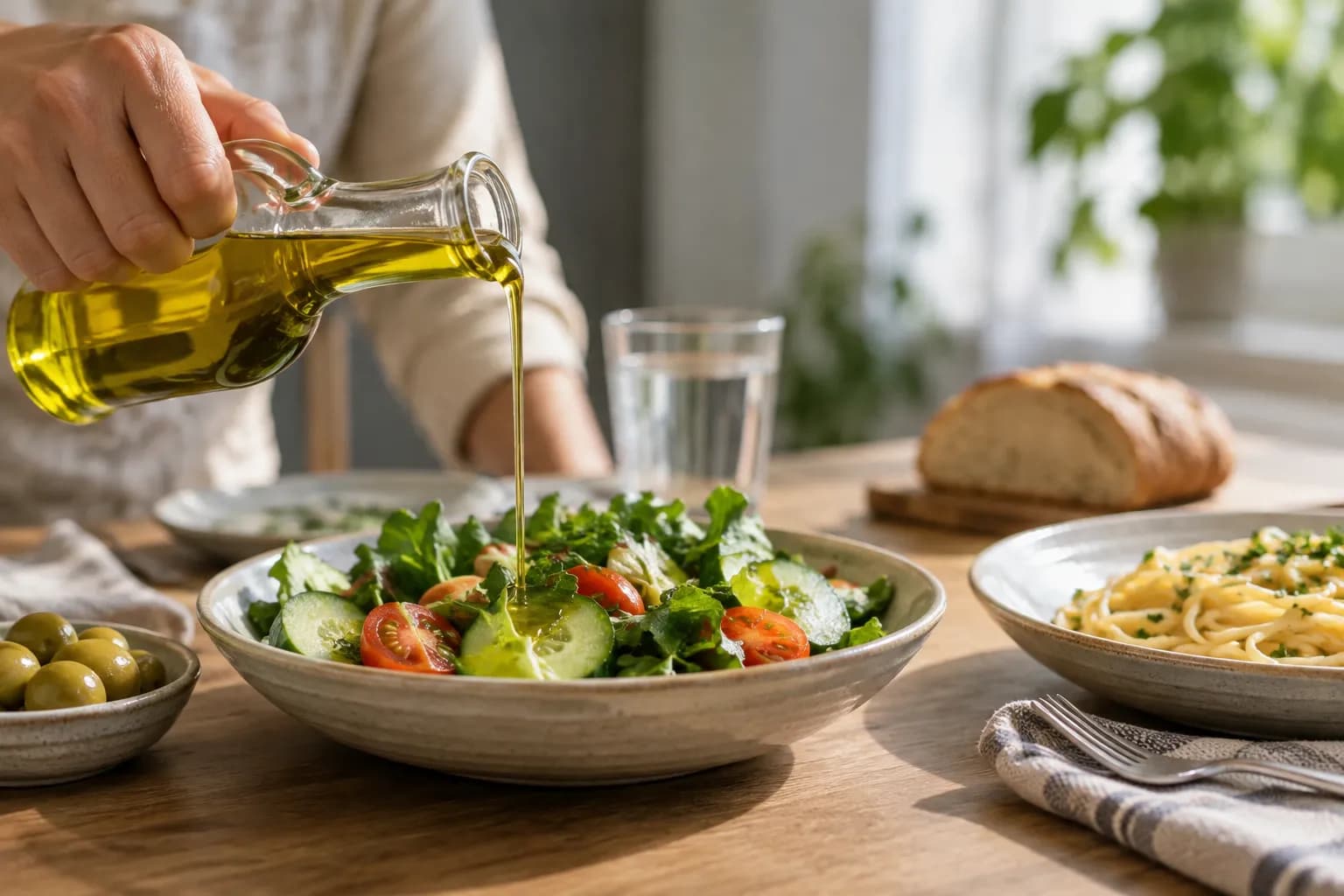
A recent scientific study by Japan's Kyoto University revealed a surprising effect of food order on blood sugar levels. Experiments showed that consuming olive oil before carbohydrates may help limit sharp post-meal sugar spikes by slowing digestion and stimulating a group of hormones and neural signals that regulate glucose levels.
These findings open the door to utilizing food order as a simple dietary method that may help improve blood sugar control without the need to eliminate entire food groups from the diet. However, the results still require clinical studies to confirm their effectiveness in humans.
How does consuming olive oil before carbohydrates affect blood sugar?
An international team of researchers conducted a series of experiments on mice to study the effect of the timing of fat consumption relative to carbohydrates on glucose levels and the hormones responsible for regulating it.
The researchers divided the mice into three groups after an overnight fast; the first group received water then glucose, while the second group consumed olive oil 15 minutes before glucose, and the third group received glucose first then olive oil 15 minutes later.
The results showed that consuming olive oil before glucose led to a lower rise in sugar levels compared to consuming it after carbohydrates.
Consuming the oil beforehand also contributed to slowing gastric emptying, delaying the transfer of food from the stomach to the small intestine. This led to glucose reaching the intestine more slowly, thereby limiting the rapid rise in blood sugar.
Intestinal and pancreatic hormones reveal the mechanism of action
The effect of consuming olive oil before carbohydrates was not limited to slowing digestion. Researchers also observed an early rise in several hormones associated with regulating sugar levels, most notably glucagon, GIP, and GLP-1.
One of the study's most prominent findings was the unexpected role of the hormone glucagon, typically known for its ability to raise sugar levels by stimulating the liver to release stored glucose.
Researchers discovered that disabling glucagon signals alone did not prevent the positive effect of consuming oil before glucose, nor did disabling GLP-1 signals alone cause this effect to disappear.
However, when both hormonal pathways were disabled together, the effect that helped limit the sugar spike diminished, indicating that the two hormones work complementarily within a more complex mechanism to regulate glucose levels after eating.
The experiments also revealed the role of the vagus nerve, which represents an important communication channel between the brain and the digestive system, in coordinating digestion and hormone secretion. This indicates an interaction between the nervous system and digestive and pancreatic hormones.
Encouraging results in mice with type 2 diabetes
A striking finding was that the effects associated with consuming fats before carbohydrates also appeared in mice with type 2 diabetes, including animals suffering from severe insulin deficiency.
This indicates that the discovered mechanism may remain effective even when the body's ability to regulate sugar with insulin is significantly impaired.
Researchers believe that changing the order of eating foods could represent a practical approach that can be sustained, compared to diets that rely on the complete abstinence from certain food groups.
Does consuming olive oil before food help control sugar levels in humans?
Despite the promising results, researchers stressed that the experiments were conducted on mice, and the study has not yet proven that consuming olive oil before carbohydrates will achieve the same effect in humans.
Clinical studies are still needed to determine the applicability of the discovered mechanisms in improving sugar level regulation in people with or without diabetes.
The study, published in the journal Diabetes in 2026, emphasizes the importance of continuing research into the relationship between food order and the body's response to meals, as a potential pathway for developing easier and more sustainable dietary strategies for blood sugar control.