
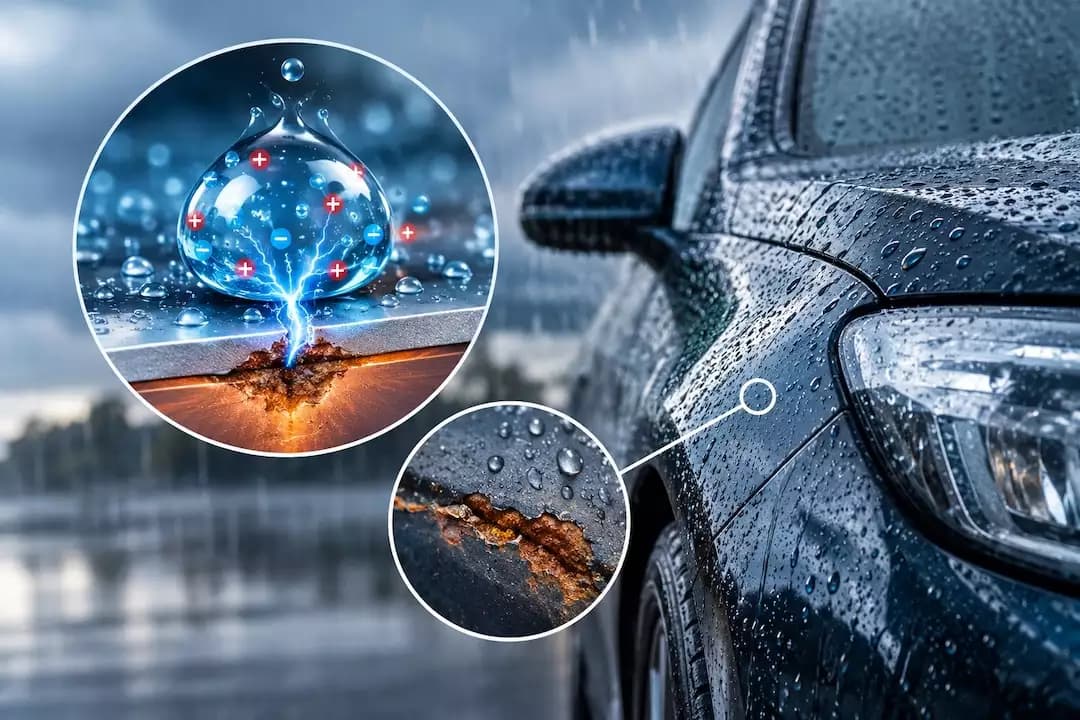
The traditional explanation for the corrosion of car paint due to rain has long been largely intuitive. Many believe that raindrops carry dissolved salts and acids to surfaces, and their repeated impact may weaken protective layers, while oxygen completes the corrosion process.
However, a recent scientific study has revealed another mechanism that has not received sufficient attention: water drops themselves can carry an electrical charge capable of penetrating insulating coatings and damaging the underlying metal surface.
The study, led by researchers Zhongyuan Ni, Rüdiger Berger, and Hans-Jürgen Butt from the Max Planck Institute for Polymer Research in Mainz, Germany, showed that water drops can reach surfaces carrying an electrical charge large enough to cause an electrical breakdown in the insulating coating, in a process somewhat similar to a spark jumping across a small gap.
How do raindrops acquire their electrical charge?
The researchers' idea stemmed from a phenomenon known as "slide electrification," which has been measured and studied more accurately in recent years. When a water drop slides over an insulating surface, such as a plant leaf, a painted wall, a window glass, or a plastic sheet, it pulls an electrical charge from the surface and leaves an opposite charge behind. Measurements have shown that water drops acquiring a charge this way can reach electrical potentials of about 9,000 volts.
To test the effect of this charge, the researchers used water drops with a volume of 35 microliters each—roughly the size of a large raindrop—and added a small amount of salt to simulate rainwater. The drops were released onto a surface tilted at a 50-degree angle, sliding for about four centimeters before falling five millimeters onto a copper plate covered with a 60-nanometer-thick Teflon layer.
The team used surfaces simulating natural conditions, including a plant leaf, a PVC foam board, transparent polystyrene used in windows, and a quartz surface coated with a fluorinated layer. The charges acquired by the drops ranged from 0.2 nanocoulombs from the plant leaf to about 2 nanocoulombs from the fluorinated quartz.
Explaining the phenomenon of "car corrosion due to rain"
The researchers noted that after exposing the copper plate to about 3,000 drops—roughly equivalent to an afternoon of moderate rain—signs of corrosion appeared on the copper, despite the protective Teflon layer.
Examination using atomic force microscopy revealed pits several nanometers deep in certain areas. These pits exceeded the thickness of the Teflon layer itself, meaning the damage did not stop at the coating but extended to the underlying metal.
In contrast, surfaces that received drops falling directly without sliding on another surface showed no damage after the same number of impacts. This supports the connection between the damage and the electrical charge the drops acquire while sliding.
Consequently, when the coating loses its insulating properties, the electrical charge penetrates it in a process known as "dielectric breakdown." This damage mechanism is similar to what can cause the failure of insulators used in capacitors and transformers.
Notably, the damage caused by raindrops can accelerate over time. Once a point in the coating is penetrated, it becomes more capable of wetting the surface and retaining water, which helps expand the damaged area. After 50,000 drops, the corroded area exceeded one millimeter.
Why are cars and metal structures affected?
In another experiment, the researchers placed a uniform layer of Teflon over a surface combining quartz and copper. When the charged drops slid over the surface, corrosion appeared specifically along the boundary between the quartz and the copper.
The researchers explain this by noting that the charged drop interacts not only with the surface it touches but also with what lies beneath it, which can provide the opposite charge. In the presence of copper, free electrons in the metal rearrange themselves under the coating, leading to an increase in the electric field between the drop and the metal, ultimately penetrating the insulating layer.
The researchers believe this mechanism could be significant for a wide range of materials and structures, not just cars. This includes bridges, ship hulls, painted steel, outdoor electronic enclosures, and metalwork in historical buildings.
Furthermore, electrically charged drops form naturally in clouds, thunderstorms, sea waves, fountains, and waterfalls, as well as in some industrial processes like electrostatic spraying and inkjet printing.
Can this type of corrosion be prevented?
The study's results indicate that increasing the thickness of the protective layer might be a solution. Polystyrene films 130 micrometers thick resisted penetration, while 12-micrometer films were penetrated.
However, increasing thickness is not always a practical solution. Some coatings must remain transparent, protective layers used in aircraft need to be light and flexible, and outdoor electronic enclosures are often designed with thin layers.
Therefore, the researchers believe the best solution may lie in developing coatings that are not only capable of resisting chemicals but also able to withstand the electric fields generated by charged drops.