Tesla returns to the spotlight with its Roadster sports car, which Elon Musk plans to launch in 2028, amid promises of exceptional performance and unconventional technologies, most notably the use of compressed nitrogen thrusters to perform aerial stunts. However, the project faces questions about the feasibility of turning these promises into an actual product, given the delay in launching the car since it was first revealed in 2017.
New Tesla Roadster Bets on Compressed Nitrogen
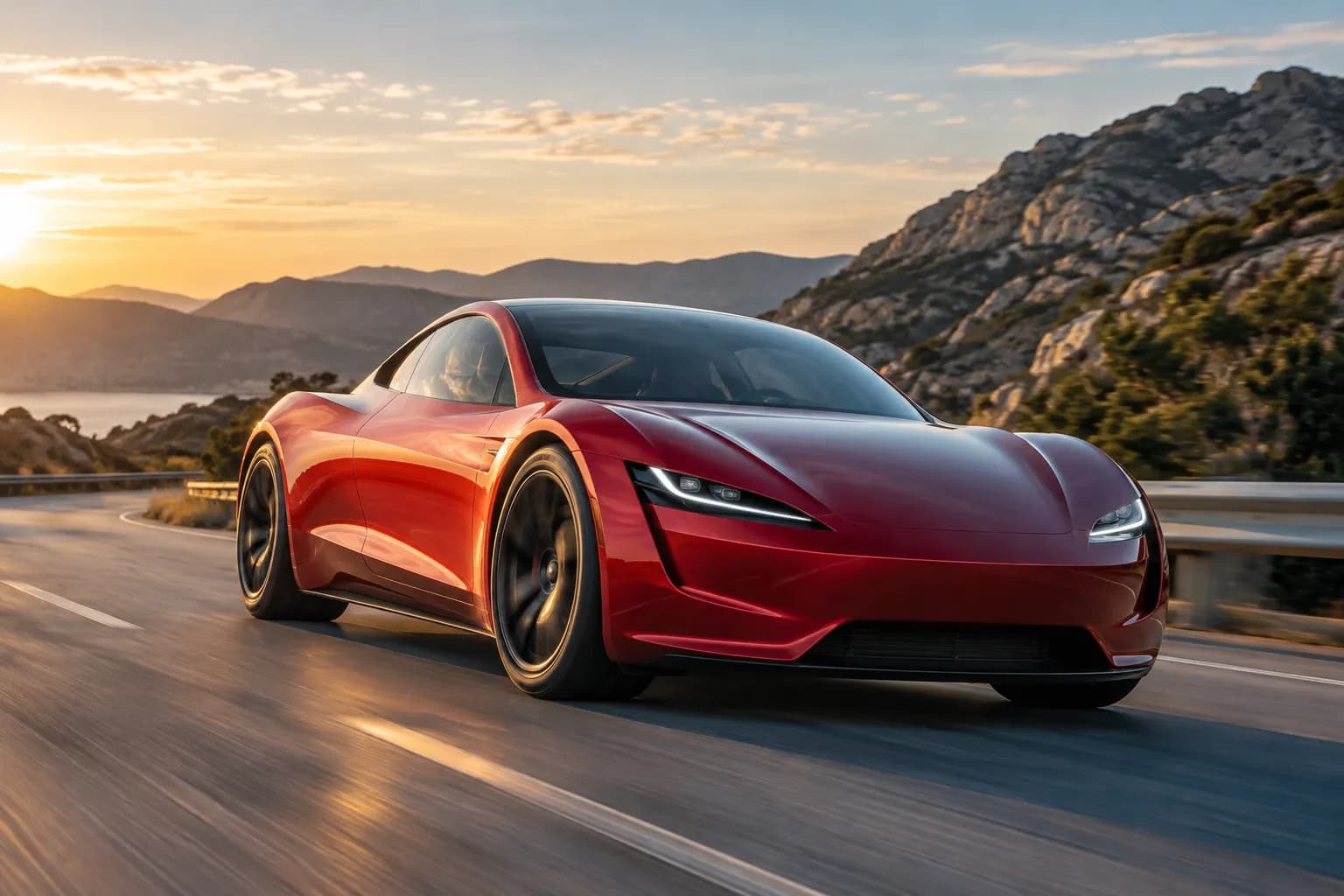
Tesla is preparing to reintroduce the Roadster with a low, aerodynamic sports design, featuring elements inspired by famous sports cars, a removable roof, and four large outlets at the rear.
However, these outlets are not connected to a traditional exhaust system. The company indicates they are designed to release compressed nitrogen thrusters at a pressure of up to 100,000 psi, as part of a system aimed at enhancing the car's stunt capabilities, including the ability to propel it to perform aerial maneuvers.
This technology raises questions about its practical application, particularly regarding safety requirements and legal restrictions that may govern its operation on public roads.
Top Speed of 616 km/h and Record Acceleration in 0.8 Seconds
The announced promises for the new Tesla Roadster include striking figures. Musk speaks of a targeted top speed of 383 mph, or about 616 km/h, along with the ability to accelerate from zero to 60 mph in 0.8 seconds.
The company says it relies on a rear-wheel-drive system, with a battery pack using 4680-type cells that Tesla is working to develop for production, along with a reference to a specific battery chemistry for this model.
However, these figures remain stated goals rather than proven performance results for a production car available to customers. This makes evaluating its actual capabilities dependent on the unveiling of the final version and independent test results.
McMurtry Spéirling Puts Tesla Up Against Real Competition
In contrast to Tesla's promises, the electric McMurtry Spéirling stands out as an example of advanced performance already achieved in some specialized electric vehicles.
According to experts, the British car can generate lateral acceleration forces of up to 3.5 Gs, compared to a target of 2 Gs for the new Roadster. The Spéirling has also achieved outstanding results in hill climbs and track trials, recording a faster time than a Formula 1 car on the Top Gear test track.
The two cars differ in design and usage, but the comparison shows that the high-performance electric vehicle market no longer relies on promises alone, but on proven figures and the ability to deliver a real product.
2028 Roadster Production Date Sparks Delay Controversy
Despite setting 2028 as a target production date, the project's track record raises doubts about adherence to the timeline. Tesla first unveiled the new Roadster in 2017 and spoke then about starting work on it, but the car has not reached customers as expected.
Some interested buyers also paid upfront deposits to reserve the car, while one customer, according to the report, faced difficulty recovering his $50,000 deposit.
These facts reinforce fears of repeated delays, especially since the announced acceleration, speed, and stunt capabilities require engineering solutions and extensive testing before being approved for a production car.
Tesla's Challenges Go Beyond Launching a Sports Car
The bet on the Roadster comes at a time when Tesla is facing pressure on its core business, with profit margins declining due to rising costs and price cuts, alongside intensifying competition in key markets like China and Europe.
The report notes that the company's relatively limited releases compared to the expansion of competitors, particularly Chinese brands offering diverse electric models at an accelerated pace, represent an additional challenge to maintaining its market share.
At the same time, Musk is expanding his interests toward artificial intelligence and space projects, with circulating possibilities of merging Tesla with SpaceX. Some reports indicate that such a move could have significant investment implications, but it does not inherently guarantee the Roadster's success or solve the challenges of the automotive sector.
Ultimately, the 2028 Tesla Roadster appears to be a project that combines technical ambition with commercial and engineering questions. The true judgment of it will depend on the actual production date, the performance proven by tests, and its ability to transition from showy promises to a car that customers can own and use.
Related Articles
- Launch of the new "Twitter" platform amid legal confrontation with "X"
- Apple announces an upcoming event on October 28.. Will it reveal the first touchscreen MacBook?
- Apple announces an upcoming event on October 28.. Will it reveal the first touchscreen MacBook?