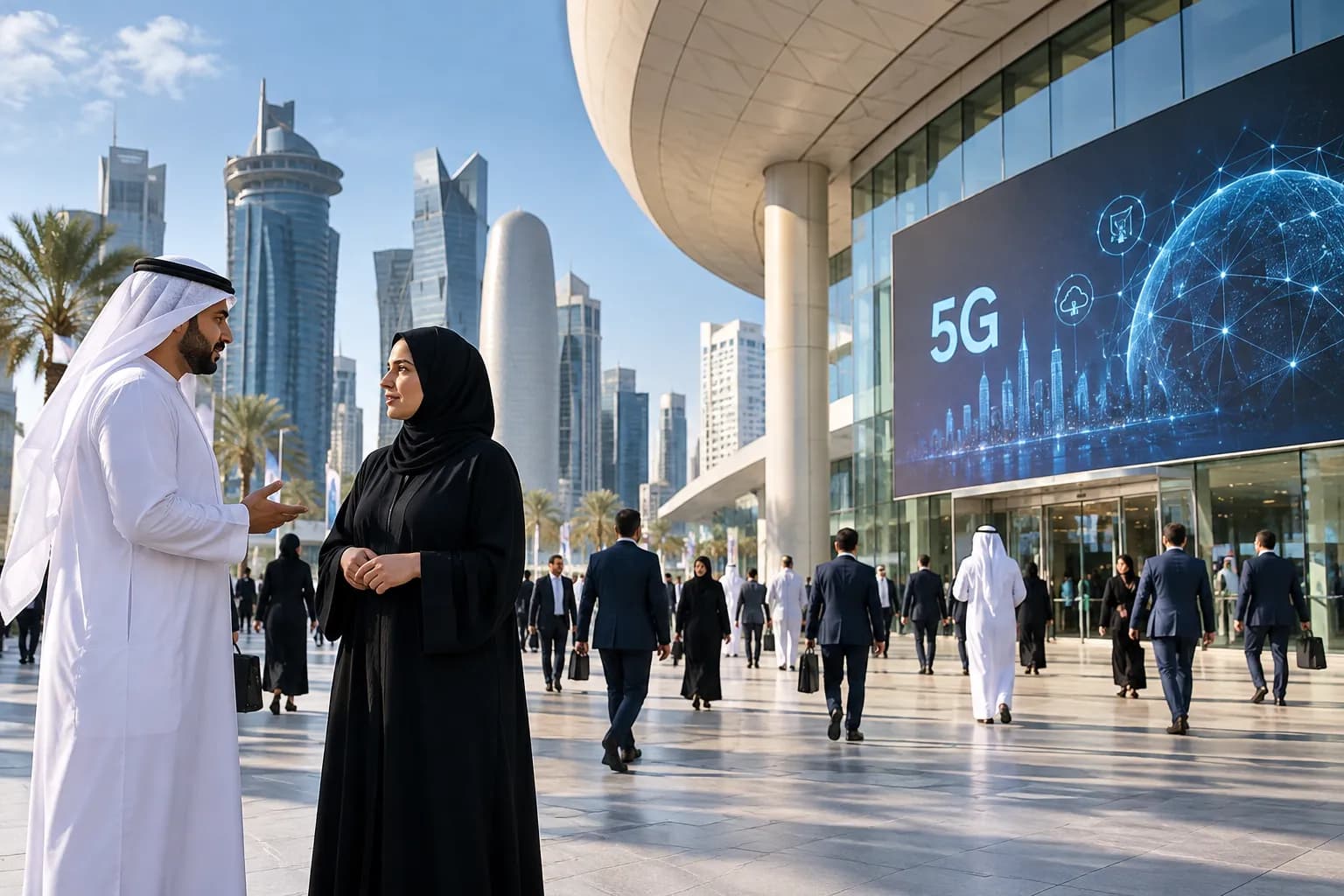
The second edition of the Mobile World Congress (MWC26) kicked off in the Qatari capital, Doha, with the participation of telecom sector leaders, government officials, and global technology companies. The event aims to discuss the future of telecommunications and digital transformation in the Middle East and North Africa (MENA) region, as forecasts indicate the mobile economy's contribution to the region will rise to $470 billion by 2030.
The conference, which opened on November 8, is held in partnership with Qatar's Ministry of Communications and Information Technology at the Doha Exhibition and Convention Center. It coincides with the International Telecommunication Union (ITU) Plenipotentiary Conference (PP-26), a move that strengthens international cooperation on the future of digital infrastructure and expanding connectivity.
AI Reshapes the Telecom Sector
The opening sessions focused on the importance of developing more resilient communication networks capable of meeting the growing demands of artificial intelligence applications, alongside enhancing international cooperation and expanding digital inclusion.
Qatar's Minister of Communications and Information Technology, Mohammed bin Ali Al Mannai, emphasized that the rapid development of AI, especially with the emergence of smart agents capable of executing tasks, imposes new requirements on telecom infrastructure and computing capabilities. He also stressed the need to diversify communication routes and ensure service continuity in the face of global challenges.
For his part, the Director General of the GSMA, Vivek Badrinath, called for enhancing global technical standards to ensure the compatibility of networks, services, and devices across different markets, in addition to intensifying efforts to connect millions of people who remain outside the scope of internet services.
Mobile Economy Approaches $470 Billion
New reports issued by the GSMA during the conference revealed the growing role of mobile communication technology in supporting the region's economies. According to the "Mobile Economy Middle East and North Africa 2026" report, the economic value generated by mobile services and technologies reached approximately $380 billion in 2025, equivalent to 5.8% of the region's GDP, with expectations to rise to $470 billion by 2030.
The sector also supported about 2.2 million jobs and contributed $40 billion to public coffers last year.
Forecasts indicate that the share of 5G networks out of total mobile connections in the region will rise from 9% in 2025 to 40% by 2030, amid expectations that telecom companies' investments will reach $88.9 billion during the same period.
Digital Divide and Challenges Facing 5G Investments
Despite rapid growth, the region still faces challenges related to digital inclusion. While 48% of the population used mobile internet services in 2025, 49% remained offline despite the availability of broadband coverage in their areas, reflecting a gap in the actual utilization of digital services.
Regarding 5G networks, another report titled "Realising the Returns of 5G in MENA" noted that 17 out of 24 markets in the region had launched commercial 5G services by September 2026.
The number of 5G connections is expected to rise from 67 million in 2025 to about 350 million by 2030, with additional investments estimated at $53 billion between 2026 and 2030 to expand coverage and develop standalone networks.
Fixed Wireless Access (FWA) services are also emerging as a promising opportunity for telecom companies to increase revenues, as they have become available across approximately 64% of commercial 5G networks in the region.
The conference's outcomes and accompanying reports highlight the transformations occurring in the MENA telecom sector, with the growing importance of investing in 5G networks, developing digital infrastructure, and turning technological expansion into sustainable economic returns while ensuring connectivity services reach broader segments of the population.