
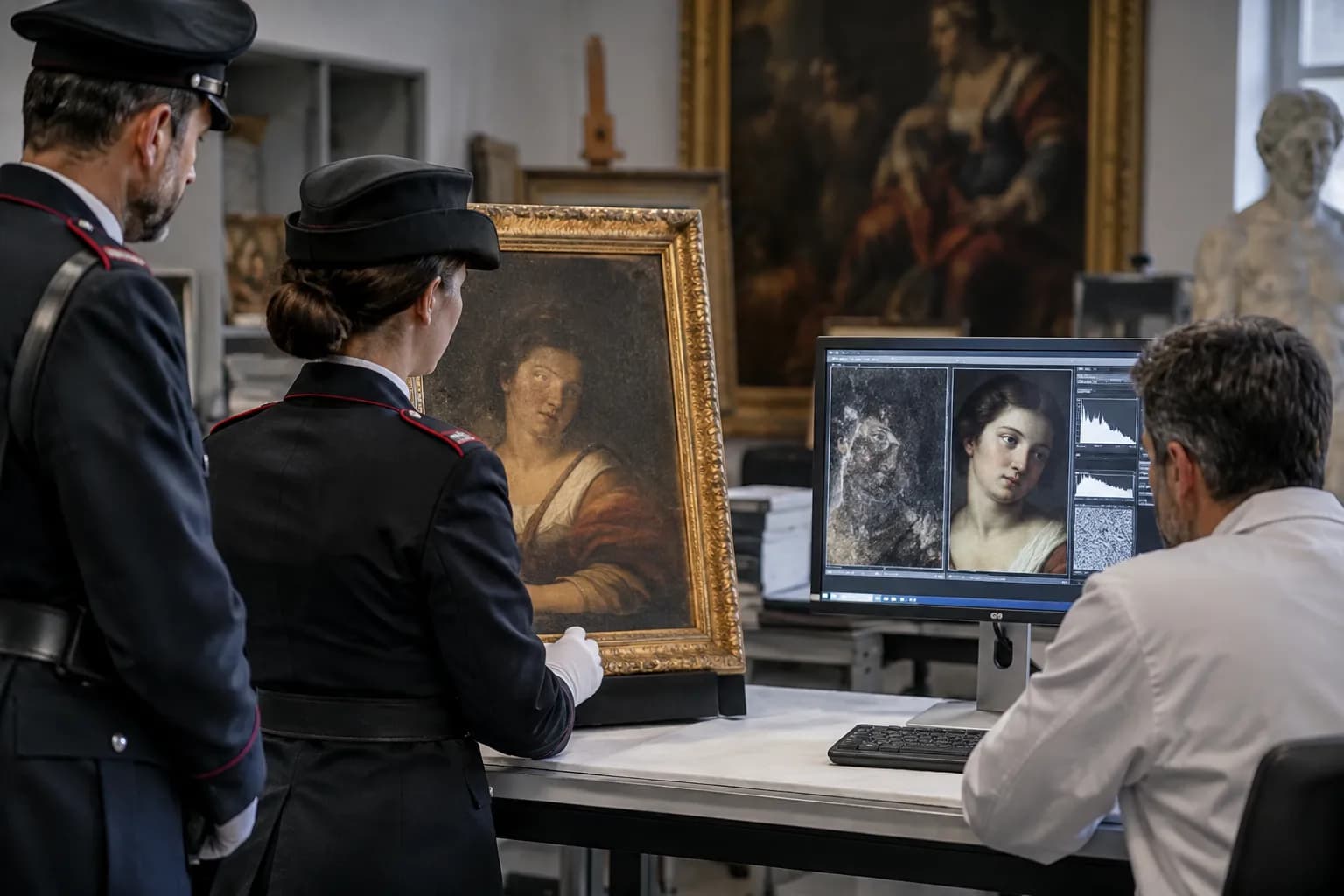
In a case that reveals how artificial intelligence can transform the fight against art and antiquity theft, Italian police successfully located a painting stolen over two decades ago, after a smart system identified it despite deliberate alterations to obscure its identity.
The story began during an annual antiques fair in the Italian city of Parma in October 2024, when officers from the Cultural Heritage Protection Unit took photos of the exhibited artworks as part of routine inspections. Within just a few hours, the AI system triggered an alert regarding a painting depicting a young woman wearing turquoise and red clothing, holding a paper scroll.
The painting aroused the investigators' suspicions, especially after noticing inconsistent details in the drawing, prompting them to confiscate it the next day and subject it to expert examination.
Religious painting hides an old theft story
Investigations revealed that the painting dates back to the 17th century, measures about one meter in height, and was stolen from a small church known as "Virgo Potens" near Naples on August 11, 2004.
However, the thieves did not just hide the painting; they altered its artistic features to make it look like a completely different work. Some parts were painted over to conceal the original religious symbols, the small lamb the saint was holding was replaced with a paper scroll, and the halo and palm branch that distinguished the figure were removed.
Despite these modifications, the AI system was able to detect the similarity between the exhibited painting and the original image registered in the stolen artworks database, relying on colors, compositions, and visual patterns, rather than just the subject of the painting or its visible details.
On May 20, 2025, the police returned the painting to the church from which it was stolen, amid the joy of local residents, in preparation for its restoration and return to its place.
Database containing over one million artifacts
The Italian police rely on a national database for stolen artifacts and artworks, established in 1969, which contains over one million items, including paintings, sculptures, coins, manuscripts, religious objects, stamps, and more.
Traditional searches used to take a long time, as investigators would compare works displayed at auctions and antique shops with images registered in the database using descriptions and keywords. However, this method was not always effective, especially since some old photos were of low quality or in black and white.
To overcome these difficulties, the Italian police developed a system called Swoads, an acronym for Stolen Works of Art Detection System, which became operational in 2020. The system can analyze the visual fingerprints of artworks and compare color tones, shapes, and compositions, even when images are unclear or parts of the work have been altered or separated.
Since the system was introduced into service in November 2023, AI has helped the Italian police recover more than 300 large paintings and sculptures, in addition to over 165,000 smaller items, with a total value exceeding 203 million euros.
AI monitors online art markets
Searches are no longer limited to traditional fairs and auctions, as investigation teams face a greater challenge with the art trade moving to online platforms, social media, and even some dark web markets.
The new system allows for continuous monitoring of auction catalogs and online advertisements, comparing them with millions of images in the stolen items database.
In another example, the system helped police in the city of Turin in 2026 recover a painting by Italian artist Filippo Palizzi, which had been stolen from a modern art gallery in June 1972, after the system spotted it offered for sale on an auction house's website.
Can AI eliminate art theft?
Despite the successes achieved by these technologies, experts emphasize that AI is not a final solution to art theft crimes, but rather an assistive tool that enhances investigators' ability to detect suspicious works.
The system can compare an image with a previously registered stolen work, but it cannot catch thieves or conclusively verify the authenticity of every piece. It may also face difficulty recognizing some three-dimensional objects, such as vases, if their shooting angle differs from the original registered image.
The quality of data used to train the systems remains a crucial factor, along with the need for specialized teams to follow up on and verify alerts. Furthermore, the technologies themselves could be exploited by forgers and criminals to alter images, digitally restore damaged parts, or create fake documents proving ownership of artworks.
International efforts to link stolen antiquity detection systems
Italy is working to expand its system's capabilities, with plans to link it to an international network for identifying stolen art and antiquities by 2027.
Other countries are witnessing similar developments. Turkey has developed an AI system that helped recover 15th-century antique tiles, German cultural institutions launched a system called Kiku, and researchers in the United States are working on using machine learning to identify statues suspected of being stolen from Cambodia.
Interpol also provides a global database called ID-Art, which allows the use of image recognition technologies to compare stolen artworks with items displayed in markets. This technology helped Spanish police recover two Renaissance tables stolen over 40 years ago, along with Roman gold coins.
Although these tools may not always succeed in uncovering major thefts, they give investigators a better chance of recovering lesser-known works that might disappear for decades in dealers' storerooms or among art market collections.