The Hajj season in Saudi Arabia is witnessing an unprecedented technological transformation known as "Smart Hajj," where crowd management now relies heavily on artificial intelligence and predictive algorithms instead of traditional methods, in a move aimed at enhancing organizational efficiency and ensuring the safety of millions of pilgrims.
Hajj is the world's largest annual human gathering, attracting over two million pilgrims in a limited geographical area and specific times, making movement and mobility management a massive challenge that requires advanced technological solutions.
With digital development, the Kingdom has transitioned from management based on human experience and reactions to a proactive smart system relying on big data and real-time analysis.
Digital Transformation in Crowd Management
Previously, crowd management relied on manual monitoring and fixed dispatching, in addition to direct intervention when congestion occurred. In the era of Smart Hajj, the system has become more flexible and accurate through the use of interactive digital maps that connect all movement elements in a single network.
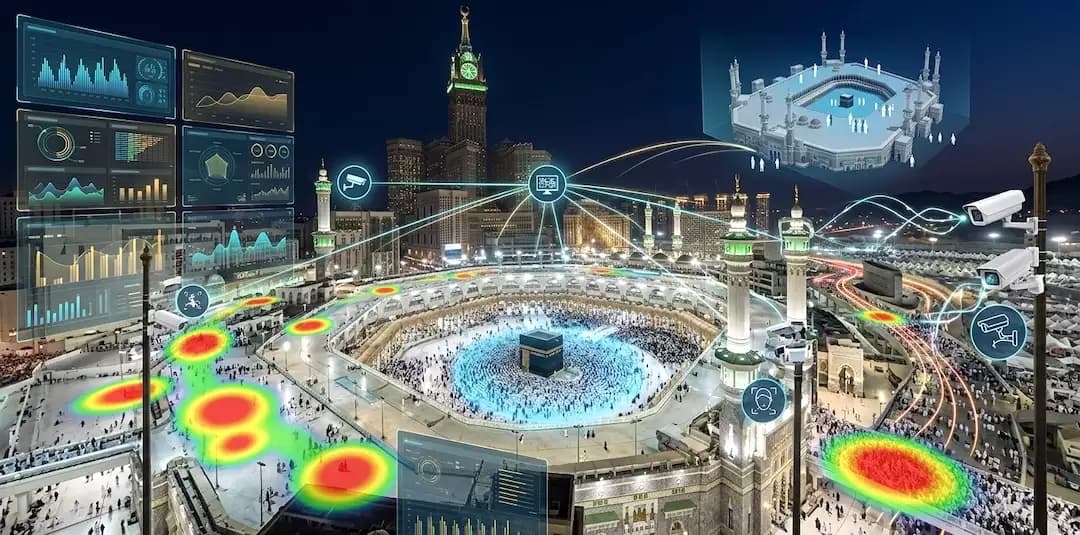
This system relies on what is known as a digital twin, a virtual model that accurately simulates the holy sites such as the Grand Mosque, Mina, Muzdalifah, and Arafat, allowing for the simulation of human flows, preventing overcrowding before it happens, and testing various scenarios.
How Does AI Predict Congestion Before It Happens?
Artificial intelligence technologies play a pivotal role in predicting congestion before it occurs by analyzing historical data and crowd behaviors from previous seasons, alongside real-time data from cameras and sensors.
Algorithms can identify potential bottlenecks, such as the Jamarat Bridge or the entrances to the Mataf, and issue early warnings to command centers, enabling proactive measures like changing routes, organizing dispatch, or temporarily closing certain gates.
Smart Cameras and Real-Time Crowd Analysis
Thousands of smart cameras have been deployed across the holy sites, transforming from traditional monitoring tools into advanced analysis systems based on computer vision and AI technologies. They are now capable of analyzing the field scene in real-time with high accuracy, including automatically counting crowds even in high densities, monitoring movement directions and individual flows within vital corridors and paths, as well as detecting abnormal behaviors such as sudden stops, falls, or moving against the flow direction, which allows for immediate alerts to be sent to the competent authorities.
These systems also contribute to the early detection of potential risks before they escalate, enhancing crowd management efficiency and supporting rapid decision-making to protect the safety of the Guests of God.
Data Integration and Decision Making
The system relies on integrating multi-source data such as Internet of Things (IoT) devices, smart pilgrim bracelets, and transportation data like the Al Mashaer train and buses, in addition to field reports.
This data is displayed at central command centers, where AI analyzes it and suggests immediate decisions that help improve crowd flow and reduce congestion, thereby increasing operational efficiency and enhancing public safety.
The Future of Smart Hajj Management
Reports indicate that these technologies have made Hajj a global model in managing massive human gatherings, as the Kingdom now uses AI to build a proactive system capable of preventing crises before they occur.
The Artificial Intelligence Authority confirms that these technologies have contributed to raising the level of safety and operational efficiency, transforming crowd management into a smart model to be emulated globally.