
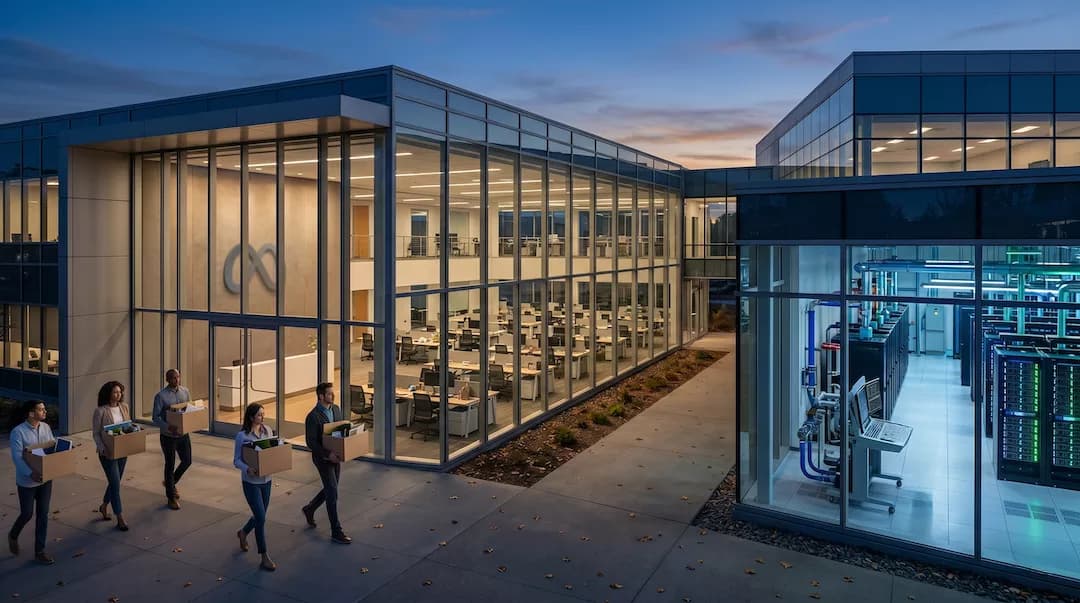
In a move confirming that artificial intelligence has become the dominant force in reshaping the labor market, Meta announced a plan to cut about 10% of its workforce, along with a hiring freeze for nearly 6,000 vacant positions, as part of its efforts to redirect spending toward developing and integrating the technology across all company departments.
Meta's strategy shift
According to an internal memo sent by the company to its employees, this move involves laying off about 8,000 employees, with implementation starting on May 20. This is an extension of a broader plan revealed in previous reports, which includes the possibility of reducing more than 20% of the total workforce of about 75,000, in parallel with the acceleration of the company's investments in artificial intelligence.
The company, owned by Mark Zuckerberg, laid off about 700 employees last March, in a move considered a clear indicator of the strategy of technology companies and the labor market in the sector in general.
Experts: AI has already begun replacing some jobs
Andy Challenger, an employment expert, explained that companies are increasingly leaning toward corporate restructuring by directing their budgets toward artificial intelligence at the expense of traditional jobs.
He noted that smart technologies have already begun replacing some tasks, especially in fields like programming, while other sectors are still testing the extent to which they can be relied upon.
According to recent estimates, the number of jobs eliminated due to artificial intelligence has reached about 30,000 since the beginning of the year, while 2025 has seen the layoff of nearly 55,000 employees as a result of the growing reliance on these technologies.
Jobs most affected by technology threats
Tech sector experts warn that administrative and clerical jobs, especially at the mid and entry levels, will be the most affected by the current wave of transformation. Dario Amodei, founder and CEO of Anthropic, noted that artificial intelligence could lead to the disappearance of half of entry-level clerical jobs, with the potential for higher unemployment rates.
In a related context, surveys by Just Capital, a non-profit organization that conducts business-related polling, showed that a third of employees are worried about losing their jobs to artificial intelligence. Meanwhile, more than half of business owners expect a decline in hiring rates for entry-level jobs, along with increased skill requirements for the remaining positions.
Data from the US Census Bureau indicates that companies in major tech hubs like San Francisco, Boston, and Seattle are adopting artificial intelligence at a faster pace compared to other regions, increasing the likelihood of jobs in these sectors being affected.