
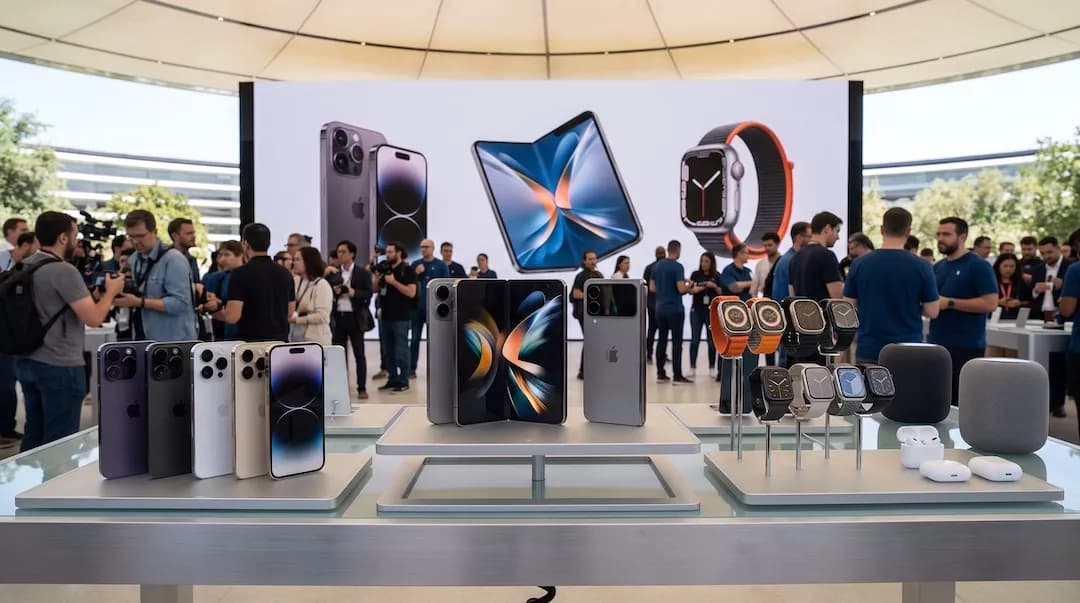
In a historic and surprising event, Apple officially announced a wide range of new products at once, led by the announcement of the iPhone 18 series and the iPhone Duo, the first foldable phone in the company's history, in addition to a new generation of watches and earbuds.
Apple revealed a new lineup of its devices during its annual event, marking one of the company's largest product updates in recent years. The event focused on artificial intelligence, performance improvements, and health, alongside Apple's official entry into the foldable phone market for the first time.
The new launches included the iPhone 18 Pro and iPhone 18 Pro Max, the foldable iPhone Duo, the Apple Watch Series 12 and Apple Watch Ultra 4, as well as the new generation of AirPods 5.
iPhone 18 Pro... Greater Focus on Camera and AI
Apple introduced the iPhone 18 Pro and iPhone 18 Pro Max as its latest flagship phones, featuring significant improvements in camera, performance, and battery life.
Both phones are powered by the new A20 Pro processor, alongside an advanced cooling system that helps maintain high performance for longer periods. The 48-megapixel Fusion main camera also received a variable aperture, giving users greater control over photography, especially in varying lighting conditions.
Apple also introduced enhancements to the professional controls within the camera app, while the Dynamic Island has become smaller and more useful.
The two phones leverage the capabilities of Apple Intelligence and iOS 27, with broader integration of AI capabilities into the user experience and the Siri AI voice assistant, as Apple continues to focus on data processing and privacy.
The iPhone 18 Pro starts at $1,199, while the iPhone 18 Pro Max starts at $1,299 in the United States. Pre-orders begin on September 12, with devices arriving in stores on September 18.
Apple Enters the Foldable Phone World with Apple Duo
The Apple iPhone Duo was the biggest surprise of the Apple event, serving as the first foldable phone developed by the company. This is a long-awaited step to compete with Samsung, Huawei, and other companies that have been in this market for years.
The phone features a horizontal folding design with a large 7.6-inch inner screen, the largest display Apple has ever offered on an iPhone, while the 5.4-inch outer screen provides a practical user experience when the device is closed.
When opened, the Duo transforms into a larger space suitable for multitasking, watching content, and gaming, with an iOS experience specifically tailored to take advantage of the foldable screen. The phone also supports the Apple Pencil, opening the door to more productive uses beyond traditional smartphone applications.
The iPhone Duo is powered by the A20 Pro processor and features a titanium design, with a hinge system built to withstand repeated folding and unfolding. The phone starts at $1,999 and will be available to users starting October 23.
Apple Watch 12: Health at the Heart of the Experience
Apple's updates were not limited to phones, as the company also unveiled the Apple Watch Series 12 with a new health sensing system.
The watch introduces the new Health Sensing System, which allows for more frequent measurement of heart rate and heart rate variability (HRV). It also features a new metric called Readiness, giving users a daily score from 0 to 10 that reflects the body's preparedness for activity based on factors like sleep, physical activity, and health status.
The watch is powered by the new S11 processor and utilizes Apple Intelligence capabilities and new AI-driven features. Meanwhile, Apple is preparing to launch a redesigned version of the Health app on iPhones later this year.
Apple states that the Apple Watch Series 12 offers the most accurate heart rate measurement in a wearable device, a step that reflects the watch's gradual transition from a mere activity tracker to a comprehensive health and fitness monitoring platform.
Apple Watch Ultra 4 Aimed at Sports and Adventures
Apple also unveiled the Apple Watch Ultra 4, targeting users interested in sports, outdoor activities, and adventures.
The watch combines the new health sensing system with the S11 chip, featuring improvements in heart rate and HRV measurement, in addition to the Readiness feature that helps users determine their preparedness level for daily activity.
Among the most notable improvements is increased battery life, as the watch can operate for up to 50 hours in daily use, while outdoor workout tracking time reaches 45 hours in certain extended operating modes, along with enhancements to the GPS system and charging speed.
The Apple Watch Ultra 4 comes in natural and black titanium options, starting at $799, and will be available in stores on September 18.
AirPods 5: Active Noise Cancellation at a Lower Price
In the audio segment, Apple introduced the AirPods 5 with an open-ear design, adding Active Noise Cancellation (ANC), which is available for the first time in this tier of AirPods at this price point.
Apple claims the AirPods 5 can reduce external noise by up to 50% compared to the ANC-equipped AirPods 4, alongside improved audio quality through a multi-port acoustic architecture and next-generation Adaptive EQ.
The earbuds also support Siri AI and the ability to interact with the voice assistant using head gestures, in addition to the Live Translation feature, which benefits from the integration between the earbuds and the iPhone.
The AirPods 5 start at $129, while the version with a wireless charging case is priced at $149, with availability beginning September 18.
Apple Bets on Device Integration with AI
Apple's new releases reveal a clear strategy for the company based on making artificial intelligence a core part of its device ecosystem, rather than offering it as a separate feature.
From the iPhone Duo, which redesigns the phone user experience, to the iPhone 18 Pro, which focuses on photography and AI, to the Apple Watch, which uses health data to provide smarter recommendations, and the AirPods, which add live translation and Siri interaction, Apple is trying to connect its products into a single, more AI-reliant ecosystem.
This shift comes at the same time the company begins a new phase under the leadership of CEO John Ternus, who succeeded Tim Cook in early September, making today's launch Apple's first major event under its new leadership.
With these launches, Apple is not merely offering updates to its current devices, but is betting on three main trends for the upcoming phase: artificial intelligence, foldable devices, and health technology, in an attempt to maintain its position in the consumer tech market as global competition intensifies.