Agentic AI technologies are opening new horizons in robotics, after researchers from the University of California, Berkeley, in collaboration with Nvidia, successfully developed a method that allows AI agents to create, test, and improve robot control programs within virtual environments before applying them in the real world.
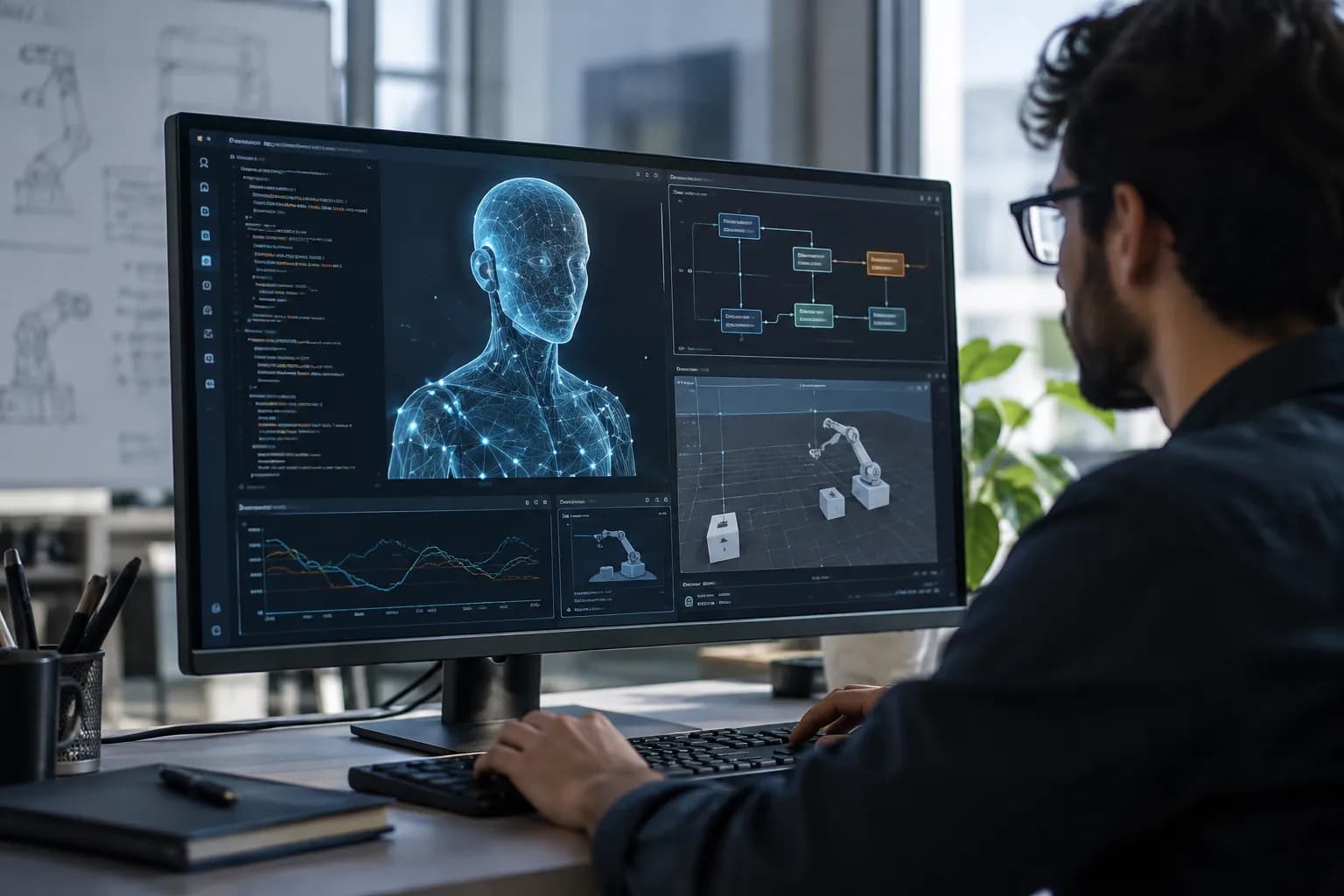
This approach, which the researchers call "Agentic Robotics," relies on breaking down complex tasks into smaller skills, such as locating and picking up objects, motion planning, and collision avoidance. A group of AI agents then links these skills into an integrated program, testing it through repeated simulations to detect and fix errors.
Simulation Reduces the Need for Data and Human Intervention
The innovation aims to overcome two of the most prominent challenges facing robot development: the need for massive amounts of training data, and the engineering time and effort required to program them.
Instead of relying on collecting data from real-world experiments or manually programming every movement, AI systems can create and improve programs through simulation, while keeping engineers responsible for reviewing results, adjusting them, and verifying their safety.
In one experiment, researchers provided OpenAI's Astra model with a video of a robot using a sponge to remove ink from a metal rod. In less than an hour, the model created a physical simulation of the scene, then developed, tested, and improved a control program for the robot before running it on a real robot that successfully executed the task.
The experiment also demonstrated the system's ability to learn from mistakes. When the robot pushed the metal rod and dropped it due to an inaccurate weight estimation, the AI used the recording of the failed attempt to update the simulation, modify the program, and try a new approach.
Increasing Industrial Robot Productivity
Ambi Robotics, a company specializing in logistics solutions and parcel sorting, has begun applying these methods to analyze sorting operation data and improve robot performance. Tests showed an increase in production capacity exceeding 15,000 additional parcels annually per robot, with updates applied to about 30% of the company's fleet in the United States.
Researchers believe this technology holds significant potential in industrial environments that rely on repetitive tasks, as it allows for faster improvement of robot performance and efficiency. However, domestic applications, such as clothes-folding robots, remain far from practical realization at present.
The UC Berkeley team announced that the project's source code is available as open-source, relying on Nvidia's Isaac simulation framework, along with a benchmark for evaluating robot performance in industrial tasks, allowing researchers and developers to test and develop the technology.