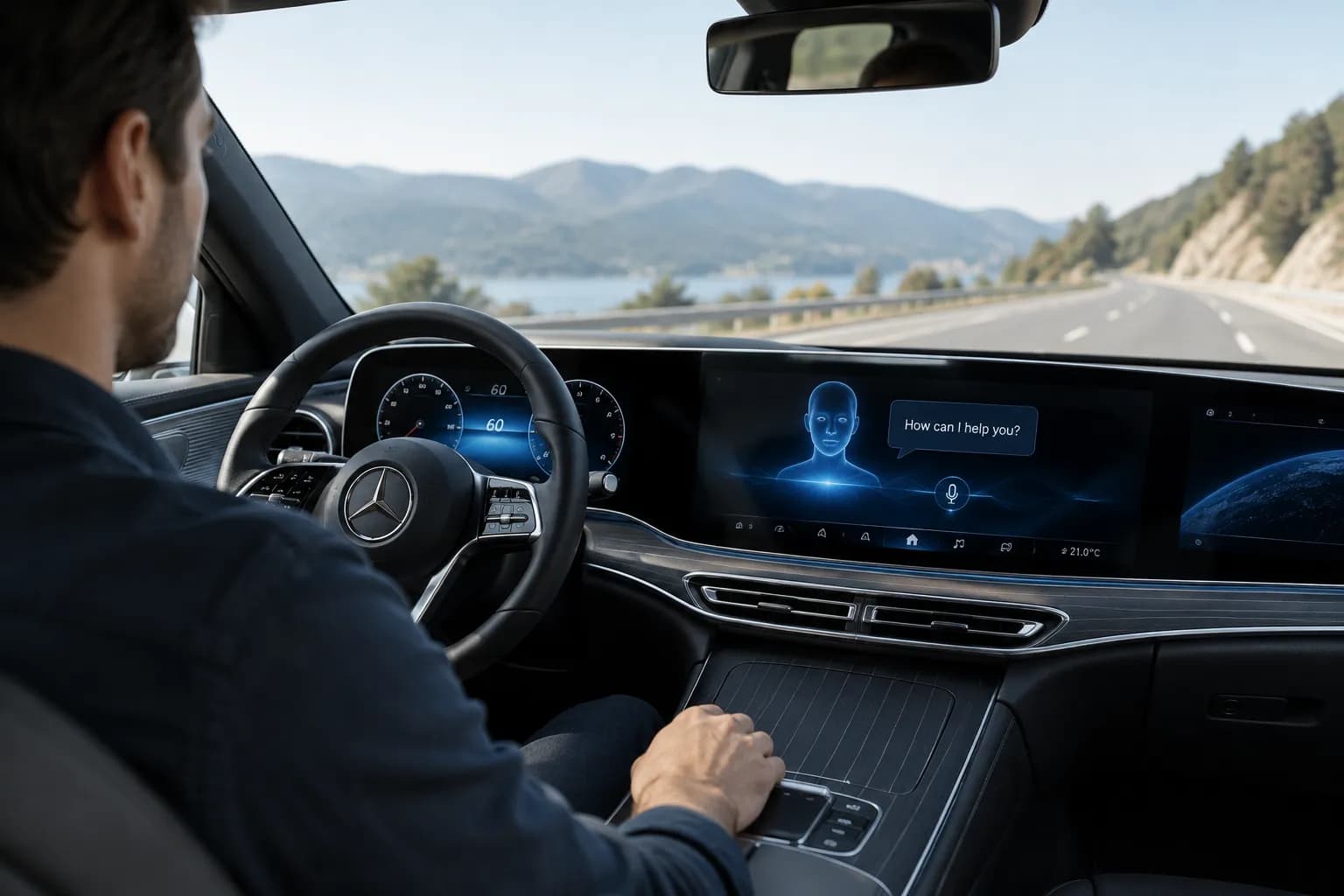
Mercedes-Benz is enhancing the in-car driving experience by integrating artificial intelligence technologies directly into its vehicles without requiring an internet connection. In collaboration with Liquid AI, an MIT spin-off, the automaker is introducing a smart, in-car conversational system rather than relying entirely on cloud computing.
The German company is betting that drivers want to interact with their cars vocally in a natural and seamless way—not to control the driving itself, but to perform daily tasks such as adjusting the temperature, controlling the entertainment system, making calls, and modifying seat settings.
In-car AI without constant internet reliance
Mercedes signed a cooperation agreement with Liquid AI last April, and in October began rolling out the new AI models in select vehicles in North America via over-the-air updates.
The technology relies on AI models designed to run directly on devices, rather than constantly sending data to cloud computing servers. According to both companies, this approach provides faster response times and a higher level of privacy, along with the ability to operate functions even with a weak internet connection.
Jason Hoff, CEO of Mercedes-Benz in North America, said that free interaction with AI systems is a major priority for customers, noting that the new technology is also characterized by its ability to better understand different accents.
Updates covering new Mercedes models
Mercedes has begun integrating the system into 2027 models, including the E-Class and CLE, along with some older models, depending on the system generation and vehicle equipment.
The company plans to expand the technology's rollout during the second quarter of 2027 to include models such as the 2027 S-Class, the electric GLC, and the GLE. It confirmed that the update will not require additional fees or a paid subscription.
Key uses include adjusting the navigation system and seats, activating the seat massage feature, controlling music, and making phone calls. Questions that exceed the local system's capabilities, such as requesting nearby restaurant recommendations, will be routed to larger cloud-based AI models.
Mercedes emphasized that this technology focuses on improving the user interface and the driver's in-car experience, and is not directly related to the autonomous driving projects the company is developing with other partners.
Why are automakers turning to local AI?
Mercedes believes that running AI inside the car offers significant advantages, most notably faster response times and reduced reliance on a constant internet connection, as well as keeping sensitive data within the vehicle instead of frequently transferring it to the cloud.
Liquid AI relies on a technical architecture known as "liquid neural networks," which are systems inspired by the neural activity of worms, characterized by their adaptability and operational efficiency.
Research and consulting firm Gartner expects that on-device AI models will handle 30% of user-initiated AI tasks in enterprise applications by 2029, compared to near-zero levels in 2026.
This trend highlights the growing importance of local AI in sectors like automotive, where certain functions require immediate responses and cannot rely on a stable connection to data centers.
This move comes as Mercedes seeks to enhance its business efficiency and improve its competitiveness amid challenges in the automotive market, particularly in China, alongside rising raw material costs.