
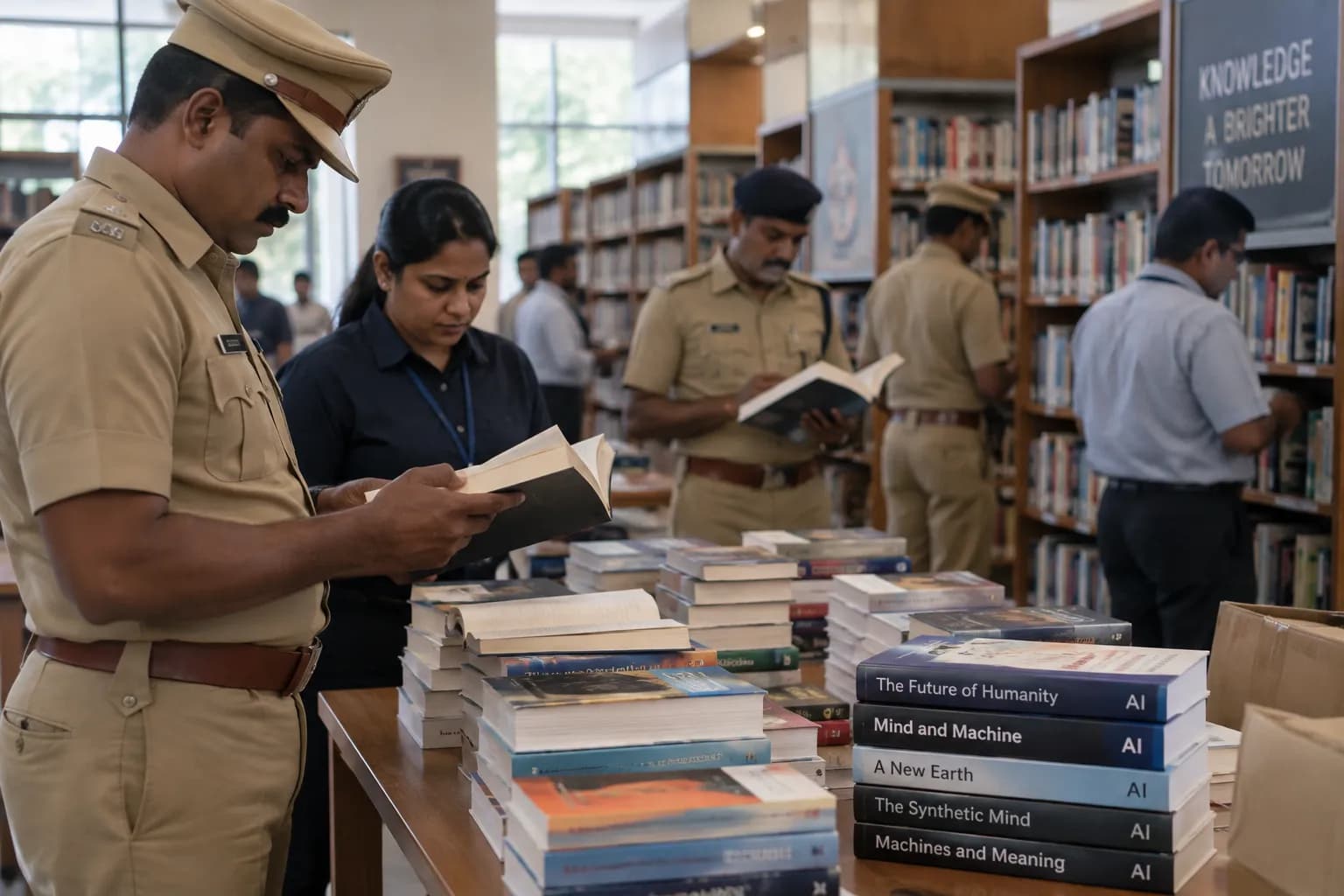
An Indian court has ordered an investigation into allegations regarding the purchase of hundreds of books suspected of being produced using artificial intelligence (AI) by a public library in the southern Indian state of Tamil Nadu, amid concerns that they contain misinformation and attribute works to people who did not write them.
The case began after prominent Tamil novelist Perumal Murugan raised questions about the accuracy of the information and the credibility of the authors in several books at a newly opened library in Coimbatore.
The Madras High Court issued a decision referring the case to the state's anti-corruption agency to investigate the book purchases, ordering the freezing of bank accounts linked to a publishing house accused of supplying these works.
Tamil Nadu School Education Minister A. Rajmoon described the case as potentially "India's first AI fraud," noting that the investigation will not be limited to the controversial library but will extend to book purchases in other public libraries across the state.
A Multimillion-Dollar Library at the Heart of the Crisis
The case centers around the Periyar Arivulagam library and center, which cost about 3 billion Indian rupees, equivalent to $34 million, to build. Tamil Nadu Chief Minister C. Joseph Vijay inaugurated the library on October 16, before it became the focus of widespread controversy over the quality and sources of its books.
Novelist Perumal Murugan sparked the issue after visiting the library last month, revealing in an article published by an online magazine that about 1,800 books in the Tamil language section came from a little-known publishing house called "Agal Vilakku Pathippagam."
Murugan pointed out that a large number of these books bear the names of unfamiliar authors, in addition to their unjustifiably high prices and suspicions regarding their International Standard Book Numbers (ISBN).
Among the controversial examples is a 300-page book titled "Naladiyar: A Guide to Life," which reportedly sells for 1,445 Indian rupees. The book attributes the title of Tamil poet and philosopher to Naladiyar, although Naladiyar is originally a classic literary work comprising 400 quatrains dealing with ethics and human values.
Reports also indicated the existence of another book that attributes the ancient Tamil poem "Madurai Kanchi" to an incorrect author.
However, it remains unclear whether AI technologies were actually used in preparing the books under investigation.
Impersonation of Prominent Authors and Questionable Information
Suspicions extended to another public library in the city of Madurai, where a book titled "Democracy and People's Rights in the Contemporary World" was found, bearing the name of well-known economist Jean Drèze as its author, published by "Phoenix Publishing."
However, Drèze confirmed in previous statements to "The Hindu" newspaper that he did not write this work, raising concerns that his name was used without his consent.
A BBC Tamil team also visited an address in Chennai registered under the name of Agal Vilakku and the other publishing house linked to the case, but found no signs or signboards indicating any commercial publishing activity at the location.
A woman at the address confirmed that Agal Vilakku operates from the premises, while its owner, Mohan, declined to comment on the allegations, merely stating that the case is before the courts.
Demands for an Independent Investigation and Review of State Libraries
The case has drawn widespread criticism from writers, academics, and publishers, who questioned the mechanisms for selecting, approving, and including books in public library collections.
More than 160 writers, researchers, artists, and publishers signed a joint statement demanding an independent investigation, the disclosure of book purchase records, and a comprehensive review of library contents across Tamil Nadu.
They also called for the recovery of public funds if the investigation proves the existence of violations or the misuse of financial resources.
The signatories questioned how these books passed the selection and approval stages, which are supposed to involve specialized committees, price negotiations, and multiple levels of review and auditing.
In response to the crisis, the state government ordered an internal review of book collections in public libraries, while Minister Rajmoon announced the withdrawal of 523 books from the historic Connemara Public Library in Chennai, after initial examinations revealed doubts about their credibility and quality.
The controversial books were also withdrawn from the Periyar Arivulagam library, as anti-corruption officials continue to examine procurement records and inspect other libraries.
AI Poses New Challenges for the Publishing Industry
The repercussions of the case were not limited to the cultural aspect but also turned into a political crisis between the current government and the Dravida Munnetra Kazhagam (DMK) party, which previously administered the state.
The Education Minister accused the previous government of being responsible for ordering the controversial books, stressing that authorities will work to recover public funds if the investigation proves violations occurred.
In contrast, the party rejected the accusations, considering them politically motivated, and demanded a comprehensive investigation into the procurement processes.
This case highlights the growing challenges facing the publishing and library sectors with the proliferation of AI tools capable of producing entire books in a short time and at a low cost, but which may in return provide inaccurate information and fabricated references, or attribute works to authors who did not write them.
It also raises important questions about the ability of cultural institutions to verify the authenticity of content before approving and publishing it, at a time when AI applications are expanding within the knowledge and publishing industry.